
Bronte Village: One Fine Day


The first thing you notice walking into Bronte Village is that people are actually here. After spending a morning in Morrison, where the prevailing sound was a distant lawn mower and the streets held maybe three passing cars, Bronte felt like arriving at a party. A quiet, well-mannered party with good food and plenty of parking. But a party nonetheless.
I had driven only a few kilometres from the gates and lawns of Cedar Grove Boulevard. In temperament and texture, though, the two neighbourhoods are a world apart. Where Morrison keeps to itself, Bronte faces outward. Where Morrison's streets are long and serene, Bronte's Ontario Street waterfront is lined with patios, painted Muskoka chairs, and people visibly enjoying a summer afternoon. Bronte pulls up a chair and invites you to sit down.

A Village That Remembers Being a Village
Bronte was founded in 1834 where Twelve Mile Creek meets Lake Ontario. For most of the 19th century, it was a working fishing port, one of the most productive on the lake, known for whitefish, lake trout, and eventually salmon. The harbour was completed two decades later, and for years the waterfront smelled of nets and fish boats, not sunscreen and soft-serve ice cream.
That history is still present. A historical marker near the creek describes the commercial fleet that once worked these waters. The old stone-hooking industry, men in flat-bottomed boats dragging shale slabs from the shallow lakebed for use in construction across the region, left its name on local streets.
And at 2403 Ontario Street, there is a pale yellow two-storey house with a narrow front veranda and white trim that made me stop and take a closer look.

It is the Duncan MacDonald-Harry Hartlands House. Thought to be a rudimentary residence built for emigrants in the years before the American Civil War, the building has lived several lives since. The Town of Oakville purchased the property and leased it to the Halton Regional Police, who used it as the village constable's office. It now serves as a residence and office, standing quietly next to the Glendella Cottage – two survivors from a Bronte that no longer exists in any other form. In another neighbourhood this building would have been demolished decades ago to make room for a six-storey condo. Here it still stands unbothered, with white-painted chairs and a stroller on the porch.
It reminded me of a house from another era, maybe one from Gone With the Wind. I found that deeply reassuring.
The Muskoka Chair as a Philosophy
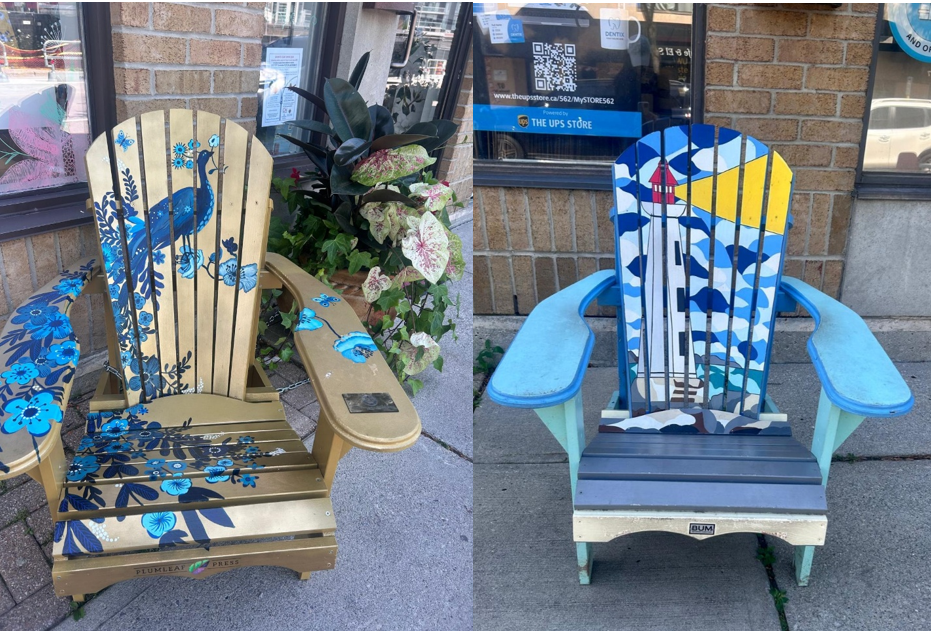
Along the Bronte Village waterfront, there is part where the sidewalk is lined with wooden panels, on which there are dozens of painted Muskoka chairs.
I watched a woman in a wheelchair and her partner sit side by side, him in a Muskoka chair, both watching the main street and the people walking up and down it. They were not talking. They were just there, doing the underrated thing of being present in a place together.
Down close to the water, an older couple sat in the shade of towering trees. The woman was gesturing toward the water, talking enthusiastically. Maybe she was pointing at a specific boat she recognised. Maybe she was telling a story from forty years ago on this same water. I could not hear her. But her partner leaned in slightly, still listening after what was clearly a long time. It can put a smile on anyone’s face.

There were also painted chairs in front of individual shops along Ontario Street, each one unique, decorated by local businesses and artists with lighthouses, peacocks, florals, and lake scenes. The chairs were just there peacefully, facing the busy street or angled toward each other in conversation. They are the kind of detail that says: this neighbourhood is not just passing through. It has decided to be somewhere.
Lunch at the Boathouse
I had lunch at Bronte Boathouse, located inside the Harbour Lighthouse Centre at 2340 Ontario Street. The building has the solid, civic look of something that has anchored this waterfront for a long time, a wide roofline, a balcony, large windows that face the harbour. Inside, the restaurant is white and airy, with the kind of elegantly relaxed atmosphere that does not try too hard.

The crowd on a weekday afternoon was almost entirely people in their sixties and seventies, dressed in the easy way that comes from knowing what suits you. Linen in cream and soft blue. Pastel sundresses. A man in a panama hat. Nobody was performing.
The energy was warm and unhurried. People were not eating quickly. They were lingering, refilling water glasses, flagging down servers with the ease of regulars. This is not a tourist crowd. These are Oakville residents who have discovered that walking to the harbour for lunch on a Wednesday is, in fact, available to them, and who have decided to take full advantage of it. That is a small but real form of wisdom.

What Bronte Understands About Aging Well
Morrison showed me what a certain kind of aging looks like: private, protected, managed, conducted behind gates and curated lawns. Bronte shows me something different. It shows aging that stays in the world. That walks down to the waterfront. That sits in a painted chair and argues about sailboats with the same passion it brought to everything else.

Aging in place in Oakville does not look the same in every neighbourhood. It is not one set of needs or one kind of day. In Bronte Village, for many people, it might mean something specific: staying mobile enough to walk Ontario Street, staying connected enough to have a lunch reservation, staying present enough to notice that the light on Bronte Harbour in late afternoon is genuinely, quietly beautiful.
The clients that Livia Care serves in Oakville are not one kind of person. Some want the total privacy of a Morrison estate. Others want the freedom to keep doing exactly what they have always done: walk to the harbour, have lunch with a friend, feel the lake wind and know, with certainty, that their life is still their own. Good home care, in Bronte, means protecting that.
I will be back in Bronte. Probably on a weekday, probably on foot, probably for lunch.

Samantha Vo is the founder of Livia Care, a boutique home care service serving Oakville, Etobicoke, and the Greater Toronto Area. The Neighbourhood Dispatch is a series in which she writes about the communities Livia Care serves - from the inside, on foot.

Comments