
A Morning in Rosedale

I came to Rosedale by the TTC. Rosedale Station is one of the few stops on the line that sits above ground, and there is something about stepping onto an open platform on a summer morning that puts you in the right frame of mind. It is a small station. But it reminds you to look up.
I turned right from the exit onto Crescent Road, and I could feel the ravine before I could see it. Crescent Road sits perpendicular to Yonge Street, and the contrast is immediate: the commercial strip behind you, the tree canopy ahead. That kind of transition does not happen everywhere in Toronto. Here it happened within a block.

The name Rosedale makes you imagine a valley full of roses, and the neighbourhood has a quality that fits. Unhurried. The houses are large without being overwhelming. The streets are green without being manicured into submission. You feel like you have stumbled into something that has been here for a long time and is in no rush to explain itself.
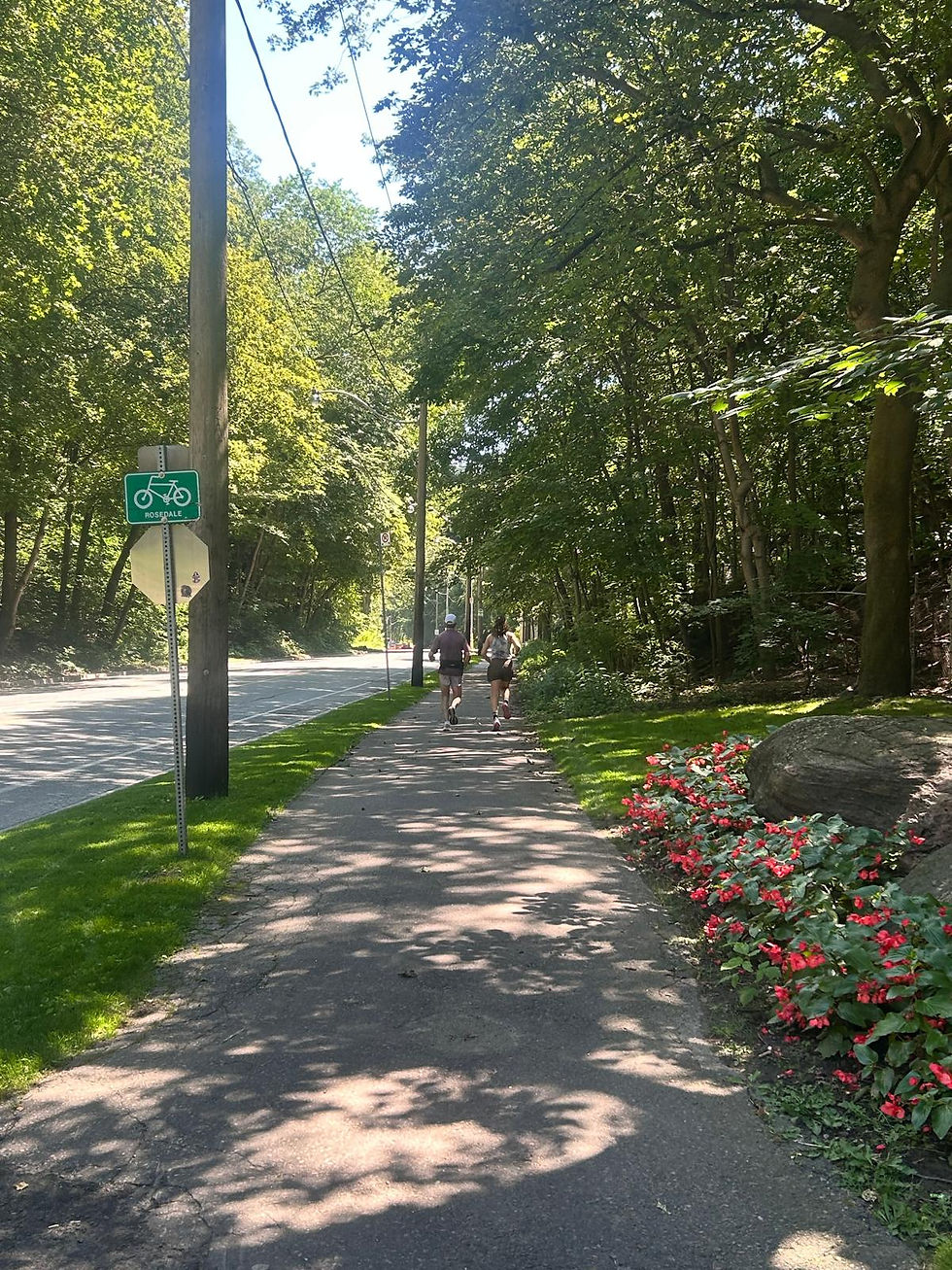
Rosedale seemed to start late this morning, or at least to take its time about it. A few people my age were pulling out of driveways, apparently headed to work. A woman in a pastel blue shirt and white culottes was walking her dog down one of the narrow trail paths that cut between the houses. An elderly father and his daughter jogged slowly along the shaded sidewalk of Rosedale Valley Road, chatting as they went. A gentleman walked quietly along Park Street, unhurried, apparently going nowhere in particular and entirely at peace with that. Near Chestnut Park, children were playing soccer in the morning sun with the kind of energy their parents on the bleachers could only admire. It was an ordinary Wednesday in the neighborhood.


A Neighbourhood That Curves
Rosedale began as a single estate in the 1820s, granted to Sheriff William Botsford Jarvis, one of the more consequential figures in early Toronto. His wife Mary named the property Rosedale after the wild roses that grew along the ravine banks. The estate was not a gentleman's hobby project. It was a working landscape, farmed in parts, with a long approach from Yonge Street that crossed a primitive bridge over the ravine and climbed steeply to the house. Mary Jarvis walked and rode on horseback along the trails that would eventually become the neighbourhood's defining streets.

After Jarvis's death, the estate was subdivided, and it was his nephew Edgar who made the decision that still shapes Rosedale today. Rather than imposing the grid already spreading across the rest of Toronto, Edgar laid out streets that followed the natural contours of the ravine landscape. Glen Road, Elm Avenue, Crescent Road: they all curve along the ravine edge, bending with the land rather than cutting across it. The approach drew from the English picturesque tradition — the idea that a landscape should reveal itself gradually, one bend at a time, rather than all at once. Rosedale became the first neighbourhood in Canada to have curved streets. Two centuries later, you can still feel what that decision gave it.
Because the roads curve, sightlines are never linear. Every bend reveals something you could not quite see from half a block back: a house, a small park appearing where you did not expect one. The street does not let you read ahead. It asks you to slow down. The whole effect, to me at least, feels like English countryside settled into the middle of a Canadian city.

The Houses
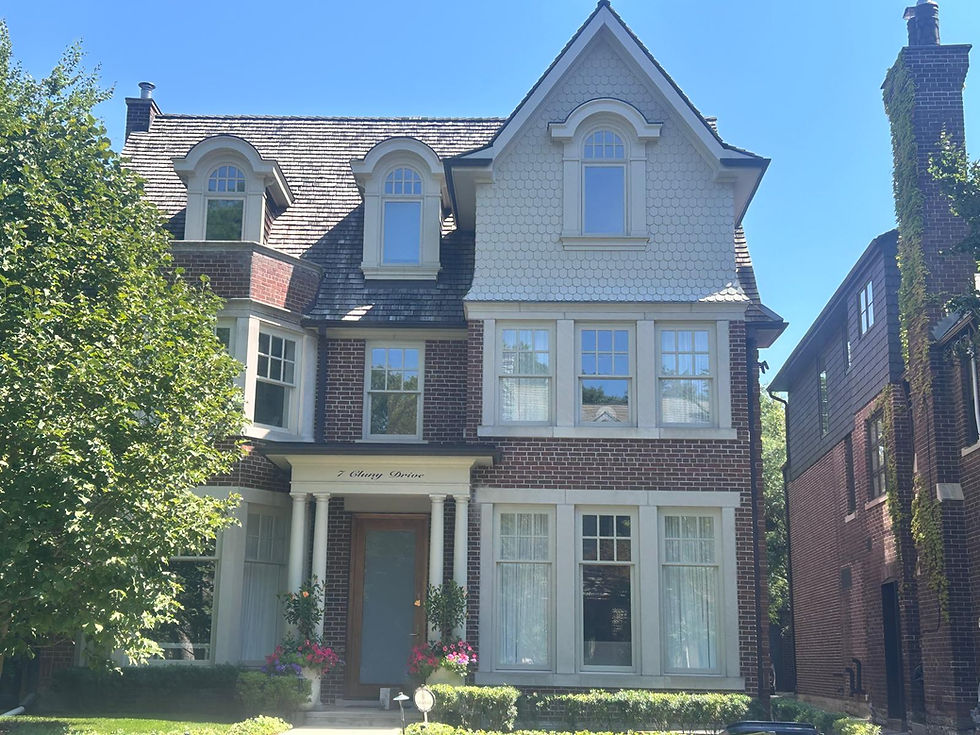
The architecture of Rosedale is not uniform, and that is what makes it work. Victorian, Edwardian, Tudor Revival, Georgian, Arts and Crafts: the houses represent several decades of building, most of them going up between the 1880s and the 1930s. Many are over a hundred years old. Some approach two hundred. And yet they do not feel like museum pieces, nor do they carry that faintly neglected quality that tends to settle on houses of that age. They feel inhabited, cared for in the specific way that only long occupancy produces. Red brick, steeply pitched roofs, wide verandas, bay windows pushing outward from the facade. Mature trees planted decades ago now dwarf the buildings they were meant to frame.
Both North and South Rosedale are heritage conservation districts, which means exterior changes are reviewed before they are made. This is why the streetscape feels so consistent — not because every house looks the same, but because every house seems to belong to the same conversation about how a street should feel. That kind of continuity is rare, and walking through it you notice it without quite being able to name it.


The Ravine at the Edge of Everything
Rosedale is built among three ravines, all preserved as parkland. The ravines are genuinely part of the neighbourhood's ecology and, for the people who live here, part of daily life. Rosedale Valley Road runs along the ravine bottom, and if you have not walked or cycled along it on a summer morning, you have missed something. It is shaded so completely by the canopy above that the temperature drops noticeably. It smells like earth and leaves, not like pavement. Despite being only minutes from Bloor and Yonge, the ravine makes Toronto feel very far away.
Residents seem to treat it as part of their daily rhythm: the morning walk, the evening run, the afternoon cycle along the valley floor. From any street in Rosedale, the ravine is within a few minutes on foot. Access to genuine urban nature — not a tidy park with a fountain but actual forest, actual bird sounds, actual shade — is something you do not come across as often as you might hope. Rosedale has had it for two centuries.


Who Lives Here, and How They Live
Rosedale has a notably older population, which I mention not to make a demographic point, but because the neighbourhood does not feel like it is winding down. It feels alive. The jogging father and daughter. The children at Chestnut Park. The gentleman on Park Street. These are not observations from different days. This was a single Wednesday morning.
There is something about the scale of Rosedale that seems to encourage this kind of neighbourhood life. The streets are narrow enough, the bends close enough, that neighbours actually see each other. You cannot live on a curving block for twenty years without coming to know the people across the street, or three houses down. Encounter feels almost inevitable here. Where Morrison offers managed separation and Bronte offers the waterfront's open invitation, Rosedale offers something more particular: the city at a human pace, on streets where you can actually see one another.


Five Minutes from Everything, Miles from Anywhere
Here is the paradox of Rosedale. Walk south for five minutes, cross Bloor Street, and you are in Yorkville: serious cafes, good restaurants, boutiques, galleries, the city in full voice. Walk back north and within two minutes it is completely absent. The hum just stops. This is not because Rosedale is isolated. It is because the neighbourhood was designed, from the beginning, to hold the city at arm's length while remaining stitched into it.
For someone thinking about what it means to age well in a city, this balance is worth sitting with. Being able to walk to a cafe on Bloor Street, run into someone you know, feel the pull of the city, and then turn back up through the ravine corridor and return to a quieter street — that combination is genuinely hard to find. Rosedale has had it built in since the 1860s.

What Rosedale Says About Aging Well
Each neighbourhood in this series says something different about how people age. Morrison offered privacy, managed separation. Bronte offered the waterfront, open and facing outward. Rosedale offers something more particular: the city, but at your own pace. Streets that curve. A ravine five minutes away. Yorkville five minutes the other direction.
The father and daughter jogging along Rosedale Valley Road, talking as they went, were not in a hurry. They were just in the right place, at the right pace. That image stayed with me longer than anything else from the morning.
When I think about what good home care looks like in a neighbourhood like this, it comes back to that same image. It is not about replacing the walk to Yorkville, or substituting for the morning jog. It is about making those things possible for longer. At Livia Care, that is what we try to support: the particular life someone has chosen, in the particular place they have chosen to live it.


Samantha Vo is the founder of Livia Care, a boutique home care service serving the Greater Toronto Area. The Neighbourhood Dispatch is a series in which she writes about the communities Livia Care serves — on foot, from the inside.


Comments